
Quad Anchor System: Limited Extension, Solid Load Distribution
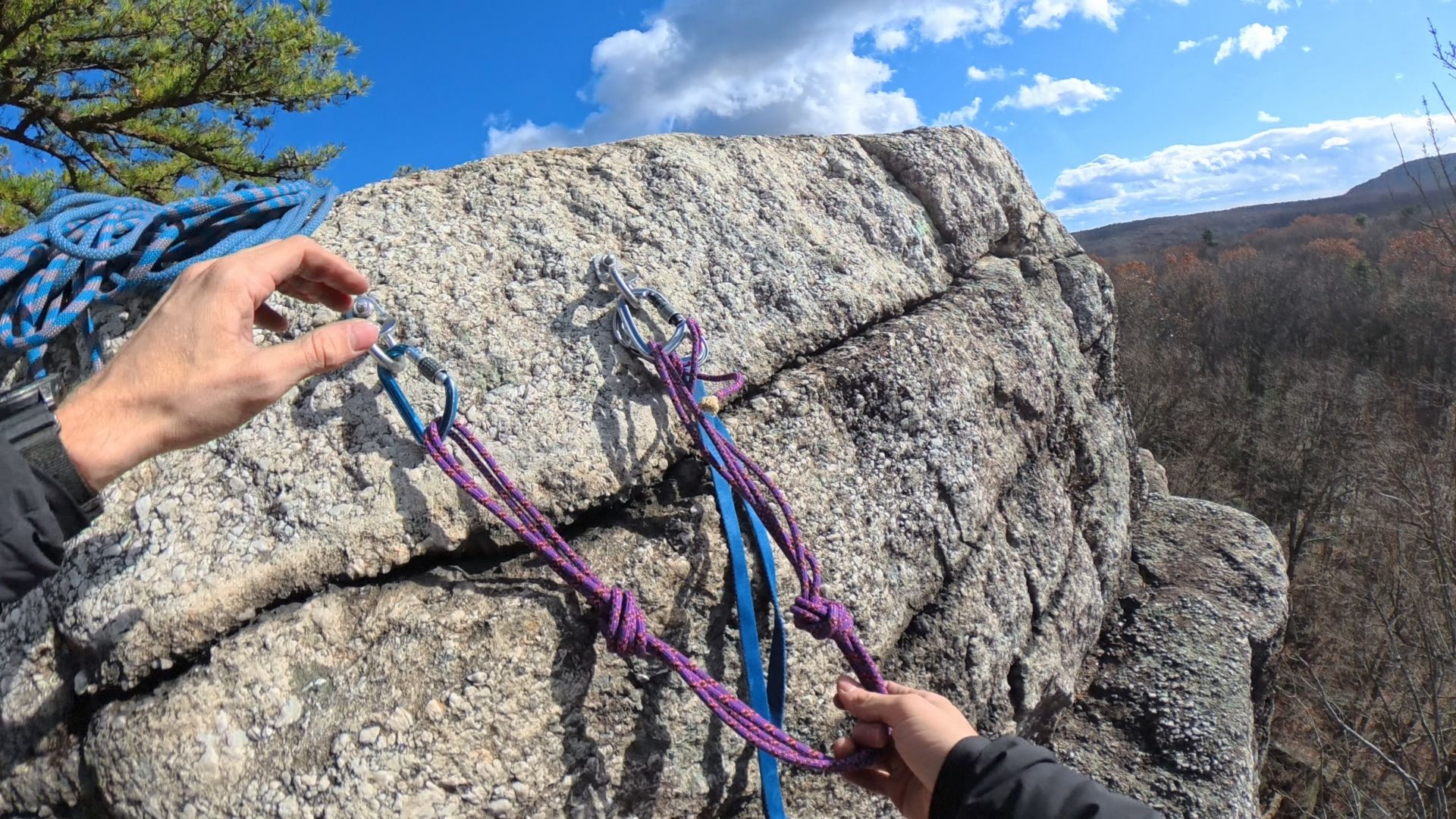
The Quad Anchor System is a compact, reliable way to connect two (or sometimes three) anchor pieces into a master point that accommodates small changes in load direction. It shines most in top-rope and some multipitch scenarios where the load stays within a predictable arc.
The core idea:
The quad provides partial equalization with limited extension, without the complexity of sliding-X systems.
What is a quad?
A quad is a conservative, predictable system — ideal for repeated load cycles (e.g., top-roping). It is not meant to be a perfectly equalizing system. The quad is designed to
- Accommodate small changes in load direction
- Provide redundancy using two or more anchor points
- Limit extension if one point fails
- Offer a stable, predictable master point
To build it, you'll need a sling or corelette:
- A 5–6m cordelette tied into a loop
- or a 120–180 cm (48–72 in)** nylon sling → most common
Use a quad when:
- 🟢 Two solid pieces
- 🟢 Predictable load direction
- 🟢 Top-rope or semi-angle multipitch
- 🟢 You want fast, clean setup
Do NOT use a quad when:
- 🔴 Three widely spaced pieces
- 🔴 Highly variable load direction
- 🔴 Upward/sideways fall risk
How to Build the Quad (Step-by-Step)
Pictures coming soon
Fold the Sling: Double the sling to create two parallel strands.
Clip Anchor Points: Clip both strand loops into each anchor point.
Tie Limiter Knots: Tie overhand knots on both sides, 6–10 inches from the anchors. These control extension if a piece fails.
Create the Power Point: Use the central strands (between the limiter knots) as the master point.
Clip Two Independent Carabiners: Clip two opposite-and-opposed locking carabiners into the master strands.
How the Quad Manages Load
The quad is a “semi-mobile” system that improves load sharing, but does not achieve perfect equalization:
- The master point can slide a few centimeters left–right.
- This allows it to self-adjust for modest direction changes.
- The limiter knots prevent excessive extension and shock loads.
A common misconception is that the quad equalizes “across 180 degrees.” In reality:
- It adjusts effectively within 20–40 degrees
- Beyond that, the master point hits a limiter knot → becomes static
- This protects the pieces but limits equalization capability
This characteristic is why the quad is great for top rope but is limited in multipitch trad anchors.
Using the Quad in Top-Rope Anchors
Top-rope loads are:
- Consistent direction
- Repeated cycles
- High total force over time
The quad excels here:
- Good distribution across two pieces
- Reliable extension control
- Stable master point
- Easily inspectable
The quad can be used on multipitch belays, but only when:
- Primary direction is well known
- Only two main pieces are needed (or 3 using “parallel strands” technique)
- You want faster transitions
- Belay is semi-hanging or hanging
Avoid using a quad in multipitch if:
- The stance is awkward and requires multidirectional load
- Pieces are far apart → large internal anchor angles
- One piece must serve as a dedicated upward directional
Common Mistakes and How to Fix Them
❌ Mistake 1: Limiter Knots Too Close to the Anchors
This reduces directional freedom and makes the quad behave like a cordelette.
Fix: Aim for 6–10 inches of free travel.
❌ Mistake 2: Clipping the Wrong Strands
Clipping outer strands instead of the inner strands compromises mobility.
Fix: Always clip the inner master strands only.
❌ Mistake 3: Using a Quad with Widely Spaced Pieces
If anchor points form a wide angle, forces multiply.
Fix: Use a cordelette or rope-based anchor.
❌ Mistake 4: Not Enough Master Point Carabiners
Only clipping a single carabiner reduces redundancy.
Fix: Clip two lockers, opposite and opposed.
10. When Not to Use a Quad
Do not use a quad when:
- Pieces are more than ~60° apart
- The anchor must handle strong upward pull
- The stance requires multidirectional load handling
- You have three primary pieces more easily handled via cordelette
- You want perfect equalization (quad won’t do it)